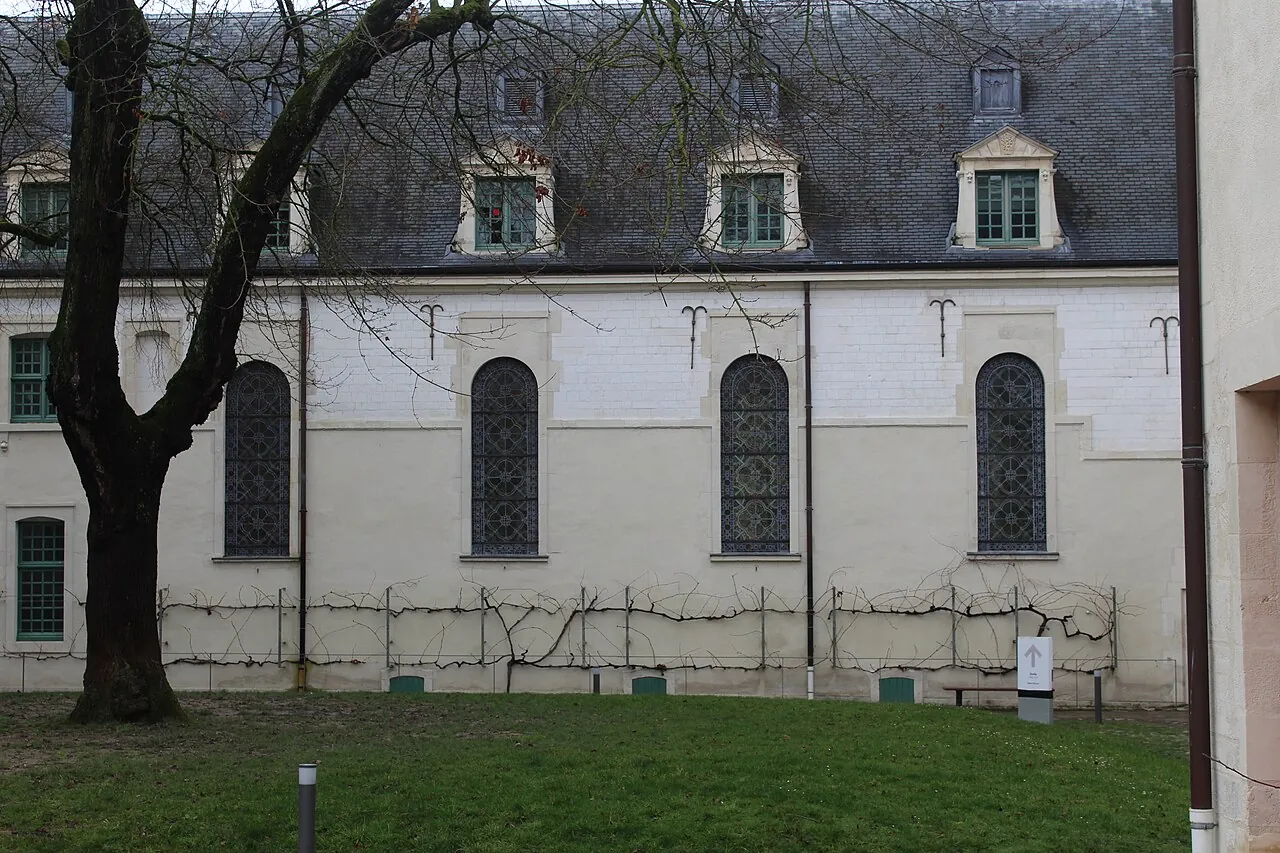
Walking up from the Basilica of Saint-Remi towards the centre, you pass a long classical building with tall, regular windows that closes off the Place Museux. Nothing on the outside says that it has been, in turn, a Jesuit college, a hospital and a university campus. Today it is the Sciences Po campus in Reims, the largest of the school’s seven campuses outside Paris. For anyone interested in the city’s history as much as its present life, the place is worth a detour, if only to make sense of it from the pavement.
A 17th-century Jesuit college
Reims has a long teaching tradition. A university was founded here in the mid-16th century by the Cardinal of Lorraine; it was in this city that Jean-Baptiste de La Salle, a Reims canon, invented the free popular school in the late 17th century and founded the Brothers of the Christian Schools. The Society of Jesus, for its part, settled in the early 17th century and opened a college — a secondary and higher teaching establishment that would train part of the region’s elite for more than a hundred years, by the Jesuits’ rigorous method. The present buildings — ranges around courtyards, chapel, refectory, library — went up in the second half of the century, in the plain, monumental style of the day. When the Jesuits were expelled from France around 1762, the college changed hands: it became a secular establishment, and then, during the Revolution and the 19th century, hospital services were installed there.
The architecture: main courtyard, staircase, chapel
The building spreads over three storeys around a main courtyard. The façade, long and set with regular bays, is a good example of French monastic architecture of the Grand Siècle: little ornament, fine proportions, a central pediment. Inside, a monumental staircase with a stone balustrade serves the floors; the chapel, built in the last decades of the century, now serves as a lecture and exhibition hall. Several parts are protected as historic monuments. Even closed to the public, the building can be admired from the square and the neighbouring streets: it is one of the largest surviving classical ensembles in central Reims.
The old library, a decor of wood and colour
The treasure of the place can be visited, but you need to know it is there: the former college library. It is a long room lined with tall carved-wood presses, under a 17th-century painted ceiling and worked panelling, one of the few such ensembles kept intact in the region. Next to it, the former refectory has also kept its decor. These rooms, owned by the city, open for guided tours and the Heritage Days; they are a reminder that an old-regime “college” was a place of scholarship as much as of teaching, holding thousands of volumes, globes and instruments.
The Carnegie library, the other book treasure of Reims
Since we are on the subject of libraries, its famous younger sibling deserves a mention: the Carnegie library, near the cathedral. Funded by a grant from the foundation of the American philanthropist Andrew Carnegie after the First World War, opened in 1928, it is an Art Deco masterpiece: mosaics, stained glass, ironwork, a hall fountain, precious woods. Entry is free and the spectacular reading room can be seen during opening hours. Between the Jesuit college and the Carnegie, Reims offers two and a half centuries of book history a few hundred metres apart.
From hospital to Sciences Po campus
For much of the 20th century the building housed hospital and administrative activities. When the modern hospital regrouped elsewhere, the city and the state looked for a use worthy of the walls. In 2010, Sciences Po opened a campus here, transferring its Euro-American programme from Paris; the Europe–Africa programme was created in Reims the following year. In about ten years the campus has become the most populous in the school’s regional network, with more than a thousand students — sometimes close to two thousand — in the quarter each year.
The model of the regional campuses
Since the 2000s, Sciences Po has spread beyond Paris: Nancy, Dijon, Poitiers, Menton, Le Havre, Reims. The principle is everywhere the same: the first two or three years of the degree (the “undergraduate college”, the equivalent of a bachelor) are spent in a regional city, with a geographical focus — Europe and North America in Reims, for instance — a compulsory third year abroad, and then the master’s in Paris. The Reims campus also offers dual degrees with major foreign universities, from New York to Tokyo. The stated aim is to widen recruitment beyond the Paris region and to internationalise each year group.
A campus turned towards Europe, Africa and the Americas
Classes are taught in English and French; students come from around a hundred nationalities and many are international. In the cafés of the quarter you hear as much English, Spanish or Portuguese as French. The campus is not open to casual visitors — it is a place of study — but the façade, the main courtyard and the chapel can be looked at from the edges, and the school regularly holds lectures open to the public, often in the evening, on international affairs.
What the campus changed in the quarter
The arrival of a thousand students, many of them foreign, has shown in the city: bookshops, cafés, small restaurants, shared flats, associations, events. The quarter, long a little sleepy between the station and the centre, has woken up. Food shops in particular have gained a young, curious clientele that lunches quickly and goes out in the evening.
Four centuries of study on the same spot
What strikes you about this building is its continuity. Since the early 17th century it has almost always been a place of teaching or care — that is, of passing on knowledge. The Jesuits staged plays in Latin here, a celebrated part of their method; generations of Reims children were schooled here before the hospital moved in. Today lecture halls have replaced classrooms and conferences have replaced scholarly disputations, but the function is the same. Sciences Po students keep some thirty clubs going — a newspaper, debating, Model United Nations, drama, charity work, sport — and, once they graduate, hold on to a “Reims” identity of their own, distinct from that of the Paris campuses. It is not rare for an alumnus to come back, years later, to show the main courtyard to their children.
Around the campus: Halles du Boulingrin, circus, Porte de Mars
The campus is flanked by monuments that are worth the walk on their own. The Halles du Boulingrin, a covered market opened in 1929, are a technical feat: a reinforced-concrete vault only about ten centimetres thick, spanning some twenty metres, the work of engineer Eugène Freyssinet and architect Émile Maigrot. Closed and threatened with demolition in the 1980s, listed, restored, they reopened in 2012 and again host a market several days a week. Next door, the former circus and riding hall, 19th-century performance spaces, now form a national stage. A little further along the Promenades stands the Porte de Mars, a 3rd-century Roman arch, and the tree-planted Boulingrin square is a breathing space in the middle of it all.
Reims, a student city
Sciences Po is only one piece of a wider whole. Reims also has a multidisciplinary university (URCA) spread over several campuses, a leading business school (NEOMA), an art and design school, a regional conservatoire, and institutes training health and engineering professionals. In all, the city hosts on the order of twenty-five thousand students, which, for a conurbation of this size, weighs heavily in its buzz, its rents and its cultural life. The closeness of Paris — forty-five minutes by high-speed train — makes it a sought-after study city, cheaper and quieter than the capital, from which you can easily “go up” for a concert or an internship. In the evening, student life gathers on the Place Drouet-d’Erlon, a long pedestrian avenue lined with brasseries halfway between the station and the cathedral; housing, meanwhile, stays more affordable than in the big university cities, which weighs on families’ choices.
Seeing the building when you do not study here
The best way to see the inside is to come for the European Heritage Days in September, or to join a tourist-office guided walk devoted to the buildings of the centre: you then see the old library, the refectory, the chapel and the galleries. The rest of the year, a stroll around the Place Museux and the Boulingrin, with a stop at the covered market and a detour to the Porte de Mars, already gives a good sense of the scale and style of the place.
Visiting a student in Reims
The campus stands on the Place Museux, right in the centre, about a ten-minute walk from the station. Many families come to Reims for a weekend with a student: it is a chance to combine the neighbourhood, lunch at the Halles du Boulingrin and a cellar visit in the afternoon. To plan a day around the city’s heritage, see also our article “Reims, capital of champagne”.
Need a local professional in Reims?
Locksmith, plumber, mechanic, vet… Tell us what you need and we will put you in touch with a trusted Reims professional. Free.
Photo : Maxime Grégoire — CC BY 3.0 · Wikimedia Commons