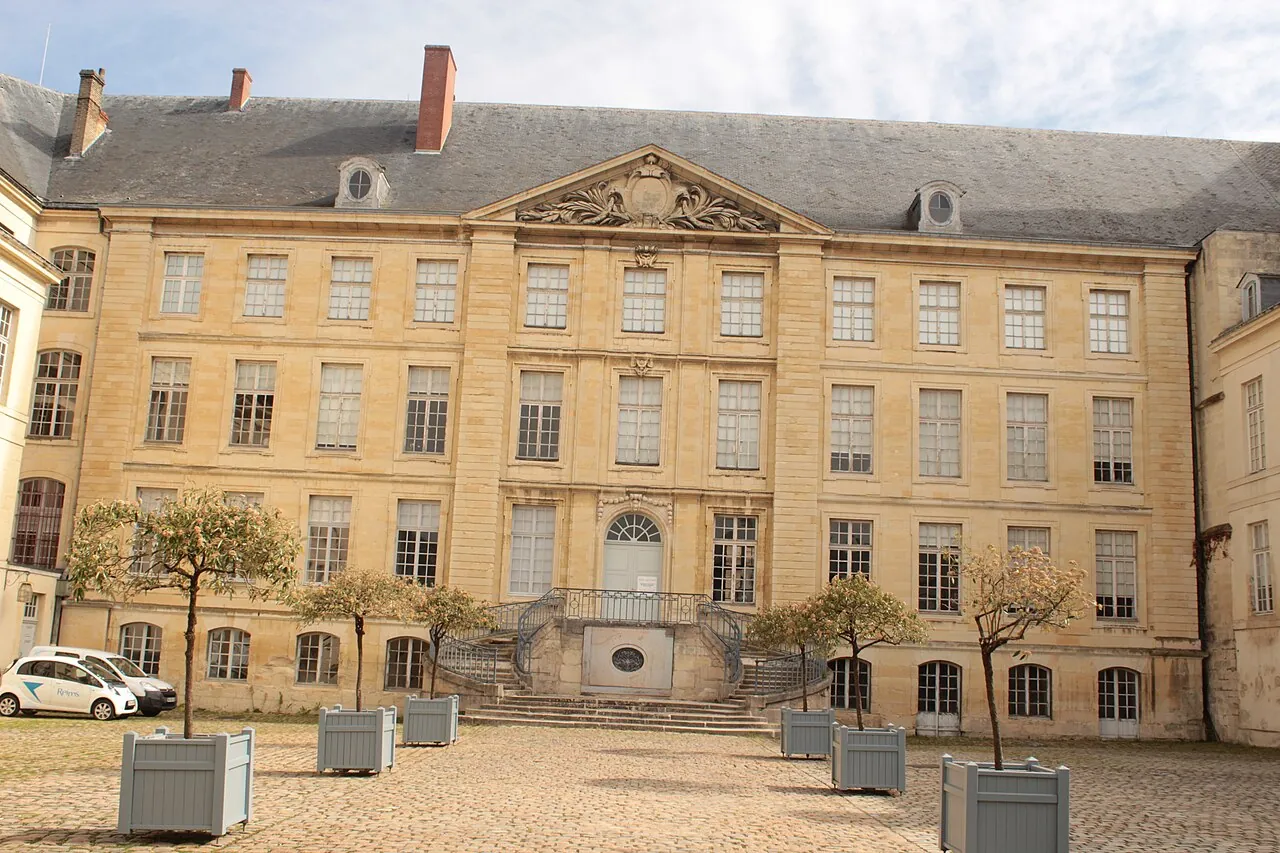
On the Esplanade Fléchambault, in the Saint-Remi quarter, you have the Basilica of Saint-Remi on one side and the long, pale buildings of its former abbey on the other. That abbey has not been a monastery since the Revolution: today it houses the Musée Saint-Remi, the city’s museum of history and archaeology. Along with the Palais du Tau, it is the place that best tells the fifteen centuries of Reims, and one of the few major museums in the region where the permanent collections are entirely free to visit. Allow an hour and a half to see it all; here is what to know before you go, so you miss nothing.
A royal abbey, keeper of the Holy Ampulla
The abbey was founded to watch over the tomb of Saint Remigius (Saint Remi), the bishop who baptised Clovis around 496 and tied the French monarchy to the city for a thousand years. Entrusted to Benedictine monks, it became one of the most powerful in the kingdom: vast farmland, a scriptorium, a school, and above all a relic without equal, the Holy Ampulla. This small vial held the oil used to anoint the king on coronation day at the cathedral. Every coronation followed the same rite: the monks carried the ampulla in solemn procession to the choir of Notre-Dame, a great lord answering for it with his life, and then the relic returned to the abbey. It was smashed in public on a Reims square in 1793; a few fragments, quietly gathered up, were later used to make a new one.
The buildings you visit today are mostly 17th- and 18th-century. After a fire and years of neglect, the community rebuilt its cloister, refectory and a grand staircase in the plain, regular classical taste. The Revolution closed the abbey and scattered the monks. In the 19th century the state installed a military hospital in the walls — which is why there are now huge rooms devoted to army history. The municipal museum, founded in town in 1834, gradually moved into these premises and settled there for good in the 1970s, after the restoration campaigns that followed both world wars, during which the basilica and its quarter were badly hit.
Listed buildings, a Renaissance cloister
The visit is worth it for the architecture alone. You cross a Renaissance cloister with finely carved arcades, the one major survival from before the classical rebuilding; you climb the 18th-century grand staircase with its wrought-iron rail; you walk a gallery opening onto formal gardens laid out behind the basilica. One room has kept its panelling and fireplace: it was the abbots’ parlour, where distinguished guests were received. The whole complex is a listed historic monument and, like the neighbouring basilica, has been on the UNESCO World Heritage list since 1991, together with the cathedral and the Palais du Tau. As you move through it, you sense how a monastery of this importance was a small town within the town, with its kitchens, cellars, infirmary and library.
What to see first
If you are short of time, three pieces sum up the richness of the place on their own:
- The tomb of Jovinus, a 4th-century Roman sarcophagus carved with a lion hunt, probably the finest antique marble kept in Reims; it long served as the burial place of important abbey figures.
- The façade of the House of the Musicians, a 13th-century Gothic dwelling whose large statues of musicians were dismantled and re-erected here to protect them from pollution and weather.
- The hanging of the life of Saint Remi, woven around 1531: ten panels of wool and silk that read like a story told in pictures.
Archaeology: from prehistory to Durocortorum
The heart of the museum is its archaeological collections, among the most complete in the Grand Est region. The first rooms cover the prehistory and protohistory of the Marne: worked flint, Gaulish burials, Iron Age jewellery and weapons, pottery, querns. The area, very fertile, was densely settled long before Rome, and large infrastructure works in recent decades — motorways, high-speed lines, business parks — have yielded thousands of objects that have renewed our knowledge of northern Gaul.
The displays have recently been rethought: the cases are clearer, the labels translated, and a straightforward chronological route leads the visitor from room to room. You can skim the whole thing in three quarters of an hour, or linger over a case of brooches or a reconstructed chariot burial.
Durocortorum, one of the great cities of Gaul
Durocortorum is the Roman name of Reims. Capital of the province of Gallia Belgica and a hub of several great imperial roads, the city probably had thirty to forty thousand inhabitants and was among the largest in the Empire north of the Alps. It had a grid of right-angled streets, a forum, baths, an amphitheatre, an aqueduct, and several monumental gates, including the Porte de Mars — the widest known Roman arch — still standing on the Hautes Promenades, a few streets from the centre. Under the Place du Forum, a long Gallo-Roman cryptoportico, a semi-buried gallery that once supported the public square, can still be visited and is run by the same museum service.
The museum holds its material memory: floor mosaics, funerary steles carved with trade scenes — a wine merchant, a cooper, a cloth dealer — fine glassware, lamps, coins struck locally, bronze statuettes, votive offerings. You can easily follow the shift from the Gaulish oppidum to the Roman city, then the slow slide into late Antiquity, when the town drew back behind its walls and Christianity took hold.
Merovingian times and the first Frankish kings
A whole section is devoted to the early Middle Ages, a key period for Reims since it is that of the baptism of Clovis. Excavations of cemeteries around the city have yielded spectacular grave goods: swords and seaxes, damascened belt buckles, eagle-shaped brooches, glassware, jewellery of gold and garnet. These objects, often exquisitely made, show a Christianised Frankish aristocracy in contact with the Mediterranean world. This is the real setting of the story told in our article “The coronation city”: the museum provides the evidence, dug from the ground.
The tapestries of the life of Saint Remi
In a long, dim gallery hang tapestries woven around 1531 for Archbishop Robert de Lenoncourt, who also gave sumptuous furnishings to the basilica. Panel by panel they tell the life of Saint Remi: the birth foretold to his mother, his rise to the episcopate, the baptism of Clovis with the dove bringing the holy oil, the miracles, the saint’s death. Each piece, several metres high, layers several scenes, with inscriptions in old French and flowered borders. It is one of the great sets of 16th-century French tapestry still kept in place; some pieces are shown in the basilica itself, others at the museum, depending on the season and conservation needs. They read from left to right, like a monumental comic strip.
Medieval sculpture and stones from the basilica
Other rooms gather Romanesque and Gothic sculpture from the basilica and from city churches now gone: capitals with foliage and monsters, engraved funerary slabs, portal statues, rood-screen fragments, recumbent effigies. Here you feel the direct link with the building next door: many of these stones come from the abbey church itself, reworked over the centuries, badly hit by the shelling of 1918 and then restored between the wars. Seeing the fragments in the museum helps you read the basilica that is still standing, and to tell what is original from what was remade.
The military history gallery
A legacy of the military hospital, a whole wing deals with army history, from the 18th century to 1945: uniforms, flags, edged weapons and firearms, headgear, decorations, mementoes of the regiments garrisoned in Reims, an account of the two world wars that destroyed much of the city. The logical sequel is fifteen minutes away: the Museum of the Surrender keeps, intact, the room where Germany signed its capitulation on 7 May 1945, the subject of our article “7 May 1945”.
Around the museum: the Saint-Remi quarter
The museum occupies the top of the Butte Saint-Nicaise, a quiet district where churches, town houses and champagne houses stand side by side. On the way out you can walk up to the gates of several great houses, whose cellars run into the chalk right under the streets, or go back down towards the Place des Droits-de-l’Homme and its fountains. It is also the handiest starting point for walking to the nearby Parc de Champagne, a former sports park given to the city by a champagne house — we devote a separate article to it.
Visiting with children, accessibility
The large galleries, the armour and the chariot burials generally appeal to children; depending on the period, the museum offers activity booklets and workshops during the school holidays. The ground floors and much of the route are accessible for people with reduced mobility; a few upstairs rooms are reached by lift. There are benches in almost every room, a bookshop at the entrance, and photography without flash is allowed. Plan to leave large bags in the cloakroom.
Practical information and access
The museum is at 53 rue Simon, along from the basilica: the two are easily visited one after the other. It opens Tuesday to Sunday, generally in the afternoon on weekdays and all day at the weekend; it is closed on Mondays and a few public holidays. Admission to the permanent collections is free; only some temporary exhibitions are charged. Allow an hour and a half for an unhurried visit, more if you also go into the basilica — the two complement each other, the warm stone of the Romanesque church on one side, the display cases on the other. The museum takes part in the Night of Museums and the European Heritage Days, when rooms usually closed can be seen.
The best plan for a day: basilica and museum in the morning, lunch in the neighbourhood, then cathedral and champagne cellars in the afternoon. We set out this itinerary in our article “Visiting Reims in a day”.
Need a local professional in Reims?
Locksmith, plumber, mechanic, vet… Tell us what you need and we will put you in touch with a trusted Reims professional. Free.
Photo : Maxime Grégoire — CC BY 3.0 · Wikimedia Commons